

Table of Contents
- What Trip Mode Means for Travelers
- Building a Travel Capsule Wardrobe That Works for Any Trip
- How to Pack for a Cruise Without Overpacking
- Road Trip Outfit Essentials for Long Drives
- Matching Your Outfit to Your Destination Mode
- Zodiac Travel Accessories and Personal Touches
- Common Packing Mistakes and How to Avoid Them
- Conclusion
- Frequently Asked Questions
Last Updated: September 27, 2026
What Trip Mode Means for Travelers
Trip mode is the practice of building a single, coordinated travel look around the specific kind of journey you're taking, so every piece you pack works with the others. At Destination Mode Co., we build entire collections around this idea.
Here's the core insight most guides miss: trip mode isn't about owning more travel clothes. It's about owning fewer, better-matched pieces that all speak the same visual language.
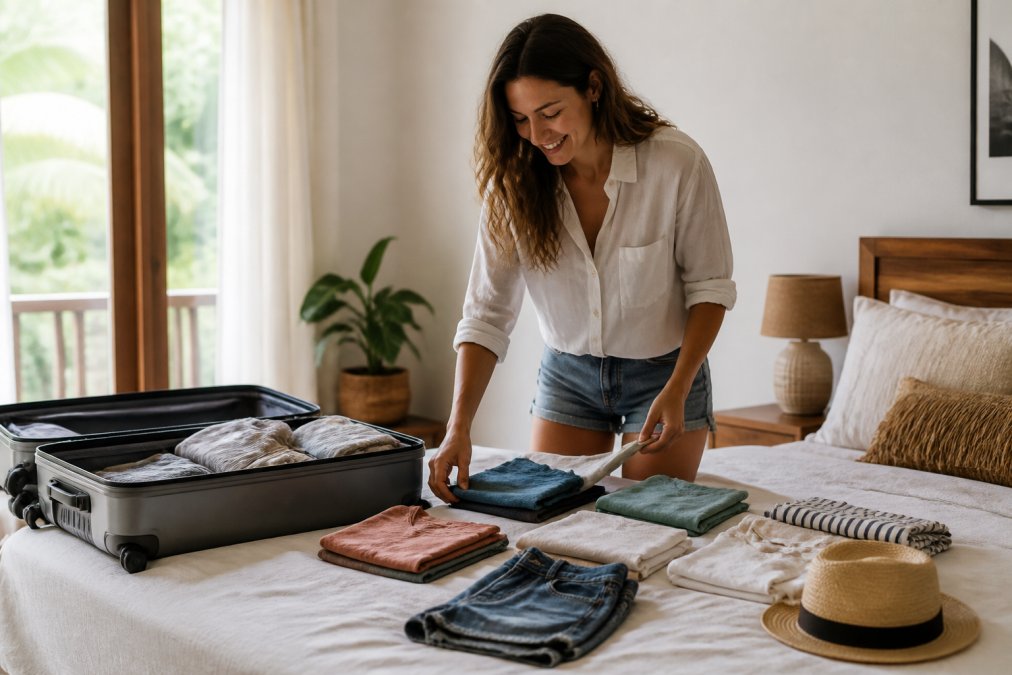
The idea works because it removes daily decisions. When your cruise outfits, road trip layers, and city pieces all follow one palette and one level of formality, packing becomes mechanical. You stop asking "does this go with anything?" and start asking "does this fit the mode?"
Think of trip mode as three connected decisions:
- Destination mode: Beach, Mountain, City, Cruise, Vegas, or Road Trip
- Activity mode: Lounging, hiking, dining, sightseeing, or driving
- Coordination mode: How your pieces mix across all of the above
Get those three aligned and a five-day trip fits in a carry-on. Get them wrong and you'll pack three bags and still feel like you have nothing to wear.
Building a Travel Capsule Wardrobe That Works for Any Trip
A travel capsule wardrobe is a small set of interchangeable pieces built around two or three base colors, where every top works with every bottom. Most travelers find that 12 to 15 pieces cover a week-long trip comfortably, provided the pieces share a palette.
The mistake is treating a capsule as a packing list. It's a system. And like any system, it only works if the inputs are chosen for the conditions they'll actually face, fabric weight, wrinkle behavior, and dry time matter more than color theory alone.
Here's how to build one that survives real trips:
- Pick two base colors that match your destination's mood, such as sand and navy for beach modes, charcoal and olive for mountain modes.
- Choose three bottoms that all work with every top you bring. One should be a stretch-woven or ponte fabric that resists creasing after hours in a seat.
- Add five tops in varying weights for temperature swings. Favor merino or a merino-blend for the mid-weight layer, it regulates temperature and resists odor across multiple wears, which matters when laundry access is limited.
- Layer with two mid-pieces, a light jacket and a cardigan or overshirt. A packable shell that compresses to the size of a grapefruit earns its space on almost any trip.
- Finish with two pairs of shoes and one accessory that ties the palette together. One pair should be broken-in walking shoes; the other should be versatile enough for a nicer dinner.
Test each piece against two questions: does this work with at least three other items, and can I wear it twice before it needs washing? If the answer to either is no, it stays home.
A common pattern among frequent travelers is to build the capsule around a single "anchor" piece, a jacket, a dress, or a pair of pants, and then choose everything else to support it. This keeps the palette from drifting and makes the mix-and-match math obvious at a glance.
How to Pack for a Cruise Without Overpacking
Cruise packing fails for one reason: people pack for the ship and forget they're also packing for ports. A seven-night cruise typically calls for two formal evenings, five casual days, and three or four shore excursions, and each needs a different outfit.
The fix is to pack in layers of formality rather than separate outfits. Build the dressiest layer first, then let the casual layers borrow from it.
| Cruise Scenario | What You Need | Pieces to Pack |
|---|---|---|
| Formal night | One dressy outfit per two evenings | One dress or jacket, two tops |
| Sea day | Relaxed, pool-friendly | Two swimsuits, one cover-up |
| Shore excursion | Comfortable, sun-safe | Walking shoes, hat, light layer |
| Evening casual | Smart but easy | Two tops, one bottom |
Pack the formal pieces first, then build casual days around them. A single dark bottom can serve both a formal evening and a casual dinner, which cuts your bag weight without cutting your options.
A few mechanisms most cruise guides skip:
- Dress codes are enforced unevenly. Main dining rooms on most lines ask for smart casual on regular nights and formal or semi-formal on designated evenings. Specialty restaurants and buffets are usually more relaxed. Check your specific line's published dress code before you pack, because the gap between "resort casual" and "formal" varies widely.
- Onboard laundry changes the math. Many ships offer self-service launderettes or per-bag laundry service. If your ship has either, you can pack for four days instead of seven and still arrive home with clean clothes. This is the single biggest lever for cutting bag weight on a cruise.
- Shoes are the real overpacking culprit. Four pairs is the practical ceiling: one walking shoe, one dress shoe, one sandal or slip-on, and one water-friendly option. Anything beyond that eats luggage space you'll want for souvenirs on the way home.
- Shore excursions punish the wrong footwear. Cobblestone ports, tender boat transfers, and uneven ruins are common. A broken-in walking shoe matters more than a stylish one on excursion days.
Road Trip Outfit Essentials for Long Drives
Road trip outfit essentials prioritize comfort over style, but the two aren't mutually exclusive. The best road trip pieces are breathable, layerable, and wrinkle-resistant, because you'll be sitting in them for hours and stepping out into unpredictable weather.
Start with these:
- Stretch-woven pants that don't crease after four hours in a seat
- A breathable base layer in a light color for sun exposure
- A packable jacket for temperature drops at elevation
- Slip-on shoes for quick rest-stop exits
- A crossbody bag that keeps your hands free at the pump
The trick most people miss is planning for the car itself, not just the destination. Bring one dedicated "car layer" you can throw on without thinking, and keep it within arm's reach rather than buried in the trunk.
Matching Your Outfit to Your Destination Mode
Destination mode dressing means choosing a palette and formality level that matches where you're going, then letting every piece reinforce it. A Vegas trip calls for richer colors and sharper silhouettes. A mountain trip calls for earth tones and functional layers. A beach trip calls for light fabrics and bright accents.
The payoff is visual. When your outfits match your destination, your travel photos read as intentional rather than accidental, which matters if you're documenting the trip for social media.
Zodiac Travel Accessories and Personal Touches
Zodiac travel accessories add a personal layer that generic travel gear can't match. A passport holder, luggage tag, or scarf tied to your sign turns functional items into something you actually want to pull out at the airport.
What makes the difference is design intent.
Common Packing Mistakes and How to Avoid Them
The most common packing mistakes all trace back to packing for a fantasy version of your trip rather than the real one. People pack for the weather they hope for, the activities they might do, and the outfits they wish they wore.
Here's how to avoid the big four:
- Packing for "just in case" scenarios. If you haven't worn it in six months at home, you won't wear it on vacation.
- Ignoring laundry access. If your accommodation has a machine, pack for four days, not ten.
- Bringing shoes that aren't broken in. Blisters ruin trips faster than bad weather.
- Skipping a color plan. Without a palette, nothing coordinates and you overpack to compensate.
Conclusion
Trip mode turns packing from a chore into a system, and the payoff shows up in lighter bags, faster mornings, and photos that actually look put together.
Frequently Asked Questions
What does it mean to be in trip mode?
Trip mode is the shift from everyday routine into travel anticipation. It shapes what you pack, what you wear, and how you document the experience. For a beach trip, trip mode might mean linen shirts and sandals; for a mountain getaway, it means layers and sturdy boots. The idea is to match your wardrobe to the specific journey so you feel prepared and excited before you even leave home.
How do I build a travel capsule wardrobe that works for multiple destinations?
Start with neutral base pieces you can mix and match, like solid tees, versatile pants, and a light jacket. Add two or three destination-specific items that reflect your trip mode, such as a swim cover-up for a cruise or a flannel for a road trip. Stick to a consistent color palette so everything coordinates. Aim for a consistent color palette so everything coordinates.
What should I pack for a road trip versus a cruise?
Road trip outfit essentials lean practical: comfortable layers and slip-on shoes. Cruises call for a mix of casual daytime wear and one or two nicer outfits for dinner. For a cruise, pack swimwear and a cover-up.
How can I coordinate accessories with my destination without looking cheesy?
Choose one or two subtle themed pieces rather than head-to-toe matching. A zodiac necklace, a destination-specific tote, or a graphic tee paired with plain bottoms keeps the look intentional. The key is to let the accessory be the focal point and keep everything else simple. That approach reads as personal style, not costume.