

Table of Contents
- Why Most Travel Souvenir Clothing Ends Up in a Drawer
- Spotting Quality Souvenir T-Shirts Before You Buy
- Locally Made Travel Clothing: How to Find It Abroad
- Meaningful Travel Souvenirs That Tell a Story
- Alternatives to Tourist T-Shirts That Actually Look Good
- A Practical Checklist for Avoiding Tacky Souvenir Clothing
- How to Style Destination-Themed Clothing After Your Trip
- Conclusion: Buy Less, Wear More
- Frequently Asked Questions
Last Updated: October 5, 2026
Why Most Travel Souvenir Clothing Ends Up in a Drawer
Most travel souvenir clothing gets worn once, then buried at the back of a drawer. It was bought for the moment, not for real life.
Avoiding tacky travel souvenir clothing starts with one shift in thinking. Buy less, choose better, and wear it long after the trip ends.
The Real Cost of a Cheap Graphic Tee
A cheap graphic tee feels like a bargain until you do the math. Thin cotton, a cracked print, and a bad fit add up to a shirt you avoid.
That is money spent for a single photo. A better-made piece costs more up front and earns its place for years. Value comes from wears per item, not the sticker on the rack.
Spotting Quality Souvenir T-Shirts Before You Buy
Quality souvenir T-shirts share a few clear signals: heavier fabric, tight stitching, and a print that sits flat and clean.
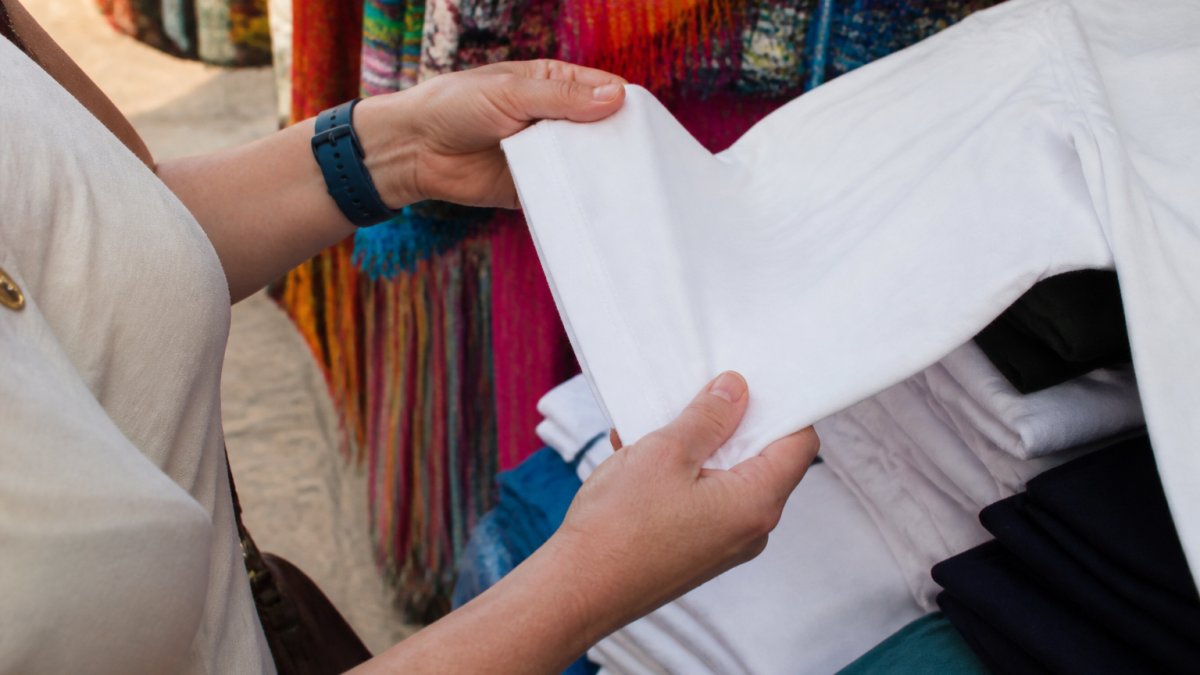
Start with the fabric. Hold it to the light; if you can see your hand through it, it is too thin to last.
Fabric Weight, Stitching, and Print Durability
Fabric weight is the best predictor of how a shirt will age. Mid-weight cotton holds its shape; thin fabric pills, stretches, and goes see-through fast. Check the label for a GSM number.
Stitching matters as much as fabric. Look for double-needle stitching at the hem and sleeves and a taped neck seam inside the collar; single-needle stitching twists and frays.
Print durability comes down to the method. Screen-printed designs with a soft, bonded feel last longest. Run your thumb across the print, a good one feels bonded to the cloth, not like a sheet sitting on top. Cracked or peeling edges are a warning sign. Here is the quick check we recommend:
- Fabric: hold to light, no see-through;
- Seams: double-needle stitching, taped neck, no loose threads
- Print: flat, soft, no cracks;
- Hem: even, no waves
- Care label: machine washable, no dry-clean-only
- Fit: try it on, do not guess
How to Check Construction and Fit in Under a Minute
Use this sequence at the stall:
- Hold it to the light. If you see your hand clearly, put it back.
- Check the inner collar. A taped neck seam (a strip of fabric covering the raw edge) prevents stretching.
- Look at the hem and sleeve ends. Double-needle stitching appears as two parallel lines of thread. Single stitching is one line and will unravel faster.
- Stretch the side seam gently. It should snap back without leaving a gap.
- Rub the print. If it feels like a sticker, it will peel. If it feels like part of the fabric, it will last.
- Try it on. A souvenir tee that does not fit your shoulders or torso will never be worn, no matter how good the print.
Travelers often skip the try-on because market stalls lack fitting rooms. Ask to try it over your clothes, or compare flat measurements against a shirt you own. That two-minute habit prevents the most common souvenir mistake: buying for the memory, not the mirror.
Locally Made Travel Clothing: How to Find It Abroad
Locally made travel clothing is worth the extra effort. It supports real makers, and the pieces are better made and more original than mass-produced merchandise.
Skip the shops beside the main square, which sell the same generic design in every city.
Markets, craft fairs, and small workshops are your best bets. Look for handwoven and traditional textiles with small variations between pieces, proof a person made it, not a machine.
Meaningful Travel Souvenirs That Tell a Story
Meaningful travel souvenirs do two things at once: they remind you of a place and fit your life at home.
Think about what you already use daily. If you live in cotton T-shirts, buy a well-made one; if you wear hats, find a local one.
Destination-themed apparel works best when the design is subtle.
Most guides push you toward the loudest, funniest option. The pieces people keep are the quiet, well-made ones.
Alternatives to Tourist T-Shirts That Actually Look Good
Alternatives to tourist T-shirts give you the same memories without the cheese, in dozens of ways that look good on a normal Tuesday.
Here are the options we see travelers love most:
- Locally made cotton T-shirt with a small, clean print
- Handwoven textile like a scarf, throw, or tote
- Destination-themed cap or beanie in a neutral color
- Zodiac accessories for travelers who follow the stars
- Practical crafts such as a woven bag or leather wallet
- City souvenir print framed for your wall at home
Each of these is a wearable souvenir or a useful keepsake. None of them screams "tourist."
Destination-Themed Apparel and Novelty Shirts Done Right
Destination-themed apparel and novelty shirts can work, the difference is design and fabric. A novelty shirt done right uses a clean graphic, good cotton, and a color you would wear anyway.
Funny travel clothing has its place, usually as a gift or group-trip joke. For your own closet, aim for a design that still makes sense when the trip is a distant memory, a beach print in summer, a mountain graphic on a hike.
A Practical Checklist for Avoiding Tacky Souvenir Clothing
Use this checklist before you pay for any travel clothing. It takes two minutes and saves you a drawer full of regrets.
- Does the design look good without the place name?
- Can you see your hand through the fabric?
- Are the seams and hem tight and straight?
- Does the print feel soft, not like plastic?
- Would you wear this at home, not just on the trip?
- Is it locally made, or mass-produced merchandise?
If a piece fails more than two boxes, leave it. The best travel finds pass almost all of them.
How to Style Destination-Themed Clothing After Your Trip
Styling a destination piece at home is easier than it sounds. Treat it like any other closet item, not a costume for special occasions. The goal is to blend the souvenir into your existing wardrobe so you reach for it on a normal Tuesday, not just when reminiscing about the trip.
Pair a graphic tee with plain jeans and clean sneakers, layer a handwoven scarf over a simple jacket, or wear a destination cap with a neutral outfit so the print is the one loud note.
Outfit Formulas That Make Travel Apparel Look Intentional
A destination tee or scarf can look stylish if you anchor it with neutral basics. Here are three formulas that work for most people:
- The everyday casual: Destination graphic tee + straight-leg jeans + white sneakers + a plain overshirt. The tee is the focal point, everything else is quiet.
- The layered look: Handwoven scarf + solid crewneck sweater + chinos + boots. The scarf adds texture and color without shouting "tourist."
- The subtle statement: Destination cap + monochrome outfit (all black, all navy, or all olive) + a simple jacket. The cap becomes the one accent.
People often treat souvenir clothing as separate from their normal clothes. Ask yourself: would I wear this if I bought it at home? If no, it will stay in the drawer; if yes, it already has a place in your rotation.
Packing, Laundry, and Customs: Practical Tips for Wearable Souvenirs
Packing: Roll knitwear and tees to save space and reduce wrinkles. Fold handwoven textiles flat in a packing cube or between layers.
Laundry: Wash prints inside out in cold water. Skip the dryer for cotton. A little care keeps the fit and the print sharp for years.
Customs and restrictions: Most countries allow personal clothing and souvenirs without duty, but items made from protected animal products (certain leathers, furs, or shells) may be restricted or require permits.
Caring for Handwoven and Traditional Textiles
Handwoven scarves, throws, and bags need different care than a cotton tee. Most natural fibers like wool, alpaca, and cotton can be hand washed in cool water with mild detergent, then laid flat to dry away from direct sunlight.
Store folded, not hung, to prevent stretching. For wool, use a breathable cotton bag and cedar blocks to deter moths. A little attention keeps your souvenir in good condition for years, not months.
Conclusion: Buy Less, Wear More
The hardest part of souvenir shopping is walking past the cheap, funny shirt and choosing the well-made piece instead. It costs more thought, and often a little more money, but it pays off every time you get dressed.
At Destination Mode Co., we build travel-themed apparel for exactly this. Our pieces are sorted by mode, from Beach and Mountain to City, Cruise, Vegas, and Road Trip, so you can match your look to your journey.
Frequently Asked Questions
How can you tell if travel souvenir clothing is good quality?
Check the fabric weight and feel the material. A quality souvenir T-shirt made from 100% cotton or a cotton blend should feel substantial, not thin or see-through. Look at the stitching along seams and hems; it should be tight and even without loose threads. Check the print quality by gently stretching the fabric where the design sits. If the print cracks or feels plastic-like, it will likely peel after a few washes. Ask about the fiber content and where the garment was made.
What makes a travel souvenir shirt look tacky?
Tacky souvenir clothing often uses generic designs, oversized logos, or slogans that feel like a joke rather than a memory. Mass-produced merchandise with poorly printed skyline designs or landmark designs in garish colors tends to look cheap. The fit matters too. A boxy, unisex cut with stiff fabric rarely flatters anyone. Clothing feels tacky when it looks like it was made for a tourist shop rack rather than for actual wear. Subtle destination prints, better fabrics, and thoughtful design avoid that trap.
Are destination-themed clothes still stylish after a trip?
Yes, if you choose pieces that work as everyday clothing. A well-made cotton T-shirt with a small destination print or a locally made textile piece can be styled with jeans, layered under a jacket, or worn to casual events. The key is avoiding costume-like designs. Destination-themed apparel that uses neutral colors, simple graphics, or classic cuts transitions easily from vacation wear to daily outfits. Think of it as a wearable keepsake rather than a one-time holiday shirt.
How do you find locally made travel clothing while traveling?
Skip the airport gift shops and hotel lobby stores. Visit local markets, artisan cooperatives, and independent boutiques in residential neighborhoods. Ask hotel staff or local café owners where residents shop for clothing. Look for handwoven textiles, traditional textiles, and small-batch production. Labels that name the maker or region are a good sign. If you are buying a gift idea or holiday gift, locally made pieces carry more meaning and usually last longer than mass-produced merchandise.
Ready to skip the tacky rack and find pieces you will actually wear? Explore the Destination Mode Co. collection and shop destinations that match your next adventure.